


Yes, you can clone a hard drive over a local network by running cloning software on the source and destination PCs. The software transfers disk data across the LAN and writes it to the selected destination disk. For a Windows system, the copy also needs the partitions required for startup, followed by checks on the destination computer.
This is useful when the drives are already installed in separate computers and you want to copy the existing setup without moving a drive between machines. Before you begin, back up anything you need from the destination disk. A clone replaces the destination’s contents rather than merging two computers’ files and applications.
Choose the Right Network Cloning Method
Direct Network Cloning vs. Image Deployment
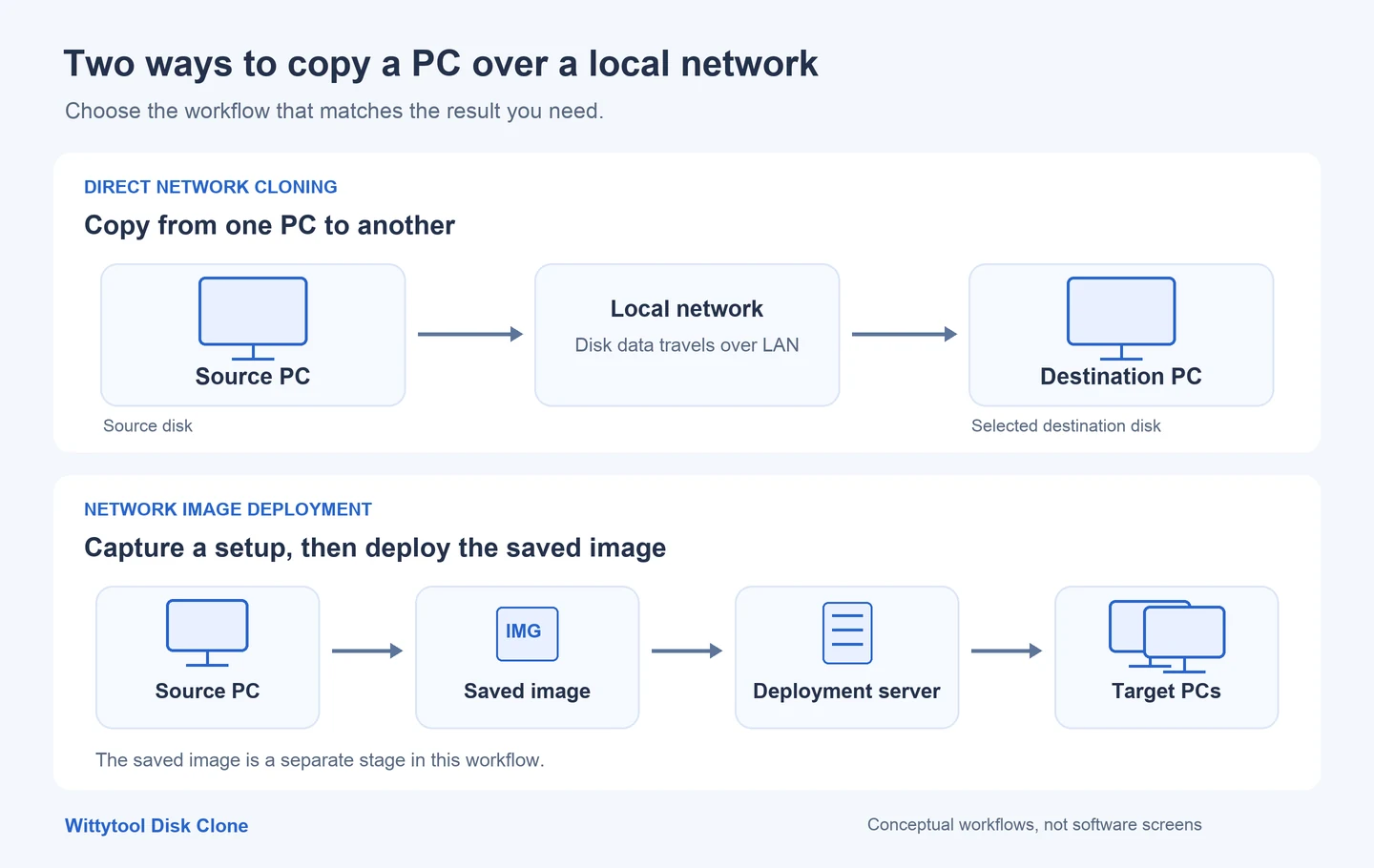
Direct network cloning copies from a source PC to a destination PC. Image deployment adds a saved image between capture and delivery. Both can transfer a Windows environment over a LAN, but they organize the work differently.
| Your task | Suitable approach | What you prepare |
|---|---|---|
| Copy a disk from one computer to another | Direct network cloning | The source PC, the receiving PC, and a working network connection |
| Reuse a prepared Windows setup across several computers | Network image deployment | A saved system image, a deployment server, and target clients |
| Keep a backup file on a NAS or shared folder | Network image backup | Network storage for the image and a restore procedure |
| Move selected documents while keeping the destination’s current Windows installation | File transfer or folder sharing | Access to the selected files and a destination folder |
For a repeatable rollout, use our guide to deploying a Windows image to multiple computers. The walkthrough below focuses on a copy between two PCs.
Disk Cloning vs. Windows Migration vs. File Sharing
Choose the copy scope by what you want to have on the destination. A full disk clone reproduces the selected disk’s partitions. Windows migration focuses on the operating system and the partitions needed to run it, while an ordinary file copy transfers selected files.
Copying the visible contents of C: to a shared folder does not create a bootable Windows installation. Windows startup also depends on supporting partitions and boot configuration. Our explanation of disk cloning and OS migration can help you decide what needs to move.
Before You Start: Prepare Both PCs and the Target Disk
Identify the Source and Destination Disks
The source contains the data you want to copy. The destination is the disk that will receive that copy. Record each computer’s name and the relevant disk’s model, capacity, and partition layout before starting.
Use those details together to identify the disks. A label such as Disk 0 identifies a disk within one computer’s current environment; it does not tell you whether that disk is the source or destination. Drive letters can also differ when you boot into a separate environment.
Check that the destination backup opens from separate storage. Keep the source available until you have verified the destination, so you still have the original environment if the first startup needs attention.
Prepare the Network and Boot Environment
Connect both PCs to the same trusted wired LAN. Each computer needs a working network adapter and a valid IP configuration, and the network must allow communication between them. Guest networks, client isolation, and separate VLANs can prevent a connection even when both computers have internet access.
The receiving software must be running before the source can connect. A computer with an empty disk therefore needs a suitable startup environment. A bootable environment is also relevant when the Windows system you intend to replace cannot remain in use during the operation.
For WinPE, test that the environment detects both the network adapter and the intended destination disk. Microsoft’s WinPE networking documentation explains network initialization and driver loading. A network adapter working in normal Windows does not establish that its driver is present in WinPE.
Keep both machines on reliable power and prevent sleep during the transfer. Close applications that could change the data being copied, and finish any pending restart before beginning the job.
Check Capacity and Windows Startup Requirements
The destination needs enough capacity for the selected copy method and resulting partition layout. Source used space alone is not sufficient to judge every mode; a sector-by-sector copy and a copy that supports partition resizing have different requirements.
For a Windows copy, review the source’s UEFI or Legacy boot mode, disk partition style, and system partitions. Also prepare storage and network drivers for the destination hardware. Copying Windows to another PC does not remove that PC’s hardware requirements or transfer every software license automatically.
How to Clone a Disk over a Network with Wittytool Disk Clone
Wittytool Disk Clone supports direct network disk cloning and Windows system migration over a LAN. Use a full disk copy to reproduce the selected disk, or Windows migration when you need the system environment on the destination PC.
Our graphical tools help you work through the copy settings. The built-in AI Disk Assistant also executes software tasks after you enter a natural-language instruction, giving you another way to use Wittytool Disk Clone’s features. The procedure below uses the network cloning and migration workflow.
Download Wittytool Disk Clone to prepare the source and receiving PCs for your LAN copy. Identify the destination disk and prepare the receiving environment before starting the connection.
Before starting the job, match the selected source and destination to the disk models and capacities you recorded. The destination will receive the copy and its existing contents will be overwritten.
Watch the Network Clone guide using Wittytool Disk Clone:
Step 1: Choose Net Copy Mode
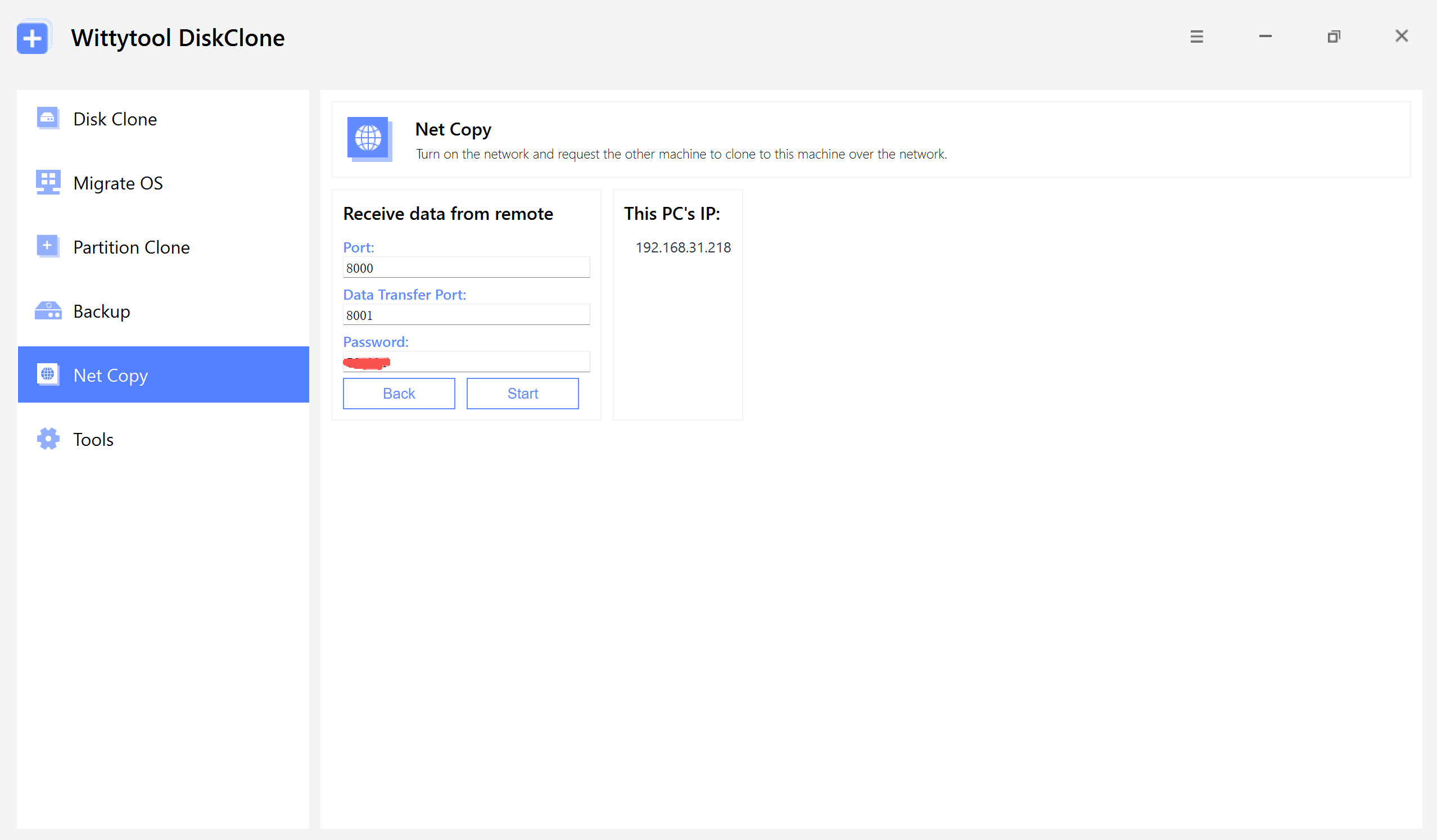
Navigate to the net copy page by selecting it from the left panel.
Step 2: Set Your Machine as the Target or Source
Designate your machine as either the target or source, then click “Next.”

Step 3: Enter the Necessary Information
Provide the required information to either send or receive data remotely. Click “Connect” to start the net copy process.
Boot and Verify the Destination PC
Start Windows from the Destination Disk
After the cloning operation has finished, restart the destination PC and select the intended local Windows boot entry. If you used a USB startup environment, remove it or choose the local disk explicitly so you do not return to the cloning tool.
Confirm that Windows starts from the destination disk. If you copied a data disk rather than Windows, check that its expected partitions are available and that you can open the copied files instead.
Check Files, Drivers, Applications, and Activation
A useful acceptance check covers the work you actually need to do on the destination:
- Compare the resulting partitions and capacities with the intended layout.
- Open representative files from different folders and partitions.
- Launch required applications and complete a small, representative task.
- Check storage, network, display, and other essential device drivers.
- Verify the intended user accounts and permissions.
- Check Windows activation, application activation, and any required sign-ins.
Keep a short record of the source, destination, copy date, and checks performed. Include any application or device that still needs attention before you put the destination PC into service.
Check Computer Identity Before Network Use
If both PCs will remain in service, review settings that should differ, including the computer name and any manually configured IP address. Handle machine identity separately from the disk transfer.
Wittytool Disk Clone includes Windows SID changing for situations that require a new local machine SID. A SID change does not perform driver installation or application activation. For business computers, the guide to cloning a domain-joined Windows PC covers the additional domain and account considerations.
Troubleshoot Network Cloning Problems
Start with the stage that failed. A connection problem, a destination-disk problem, and a Windows startup problem need different checks.
| Symptom | What to check next |
|---|---|
| The source cannot connect to the target | Confirm that the receiving software is running. Recheck the target’s current IP address and the connection settings shown by the receiving environment. Check for guest-network isolation or a firewall rule blocking the required traffic. |
| The network adapter or disk is missing in the boot environment | Check that the environment contains the appropriate network or storage driver. A missing disk cannot be fixed by changing the source PC’s IP address. |
| The destination disk cannot accept the job | Recheck its identity, capacity, accessibility, and the copy mode’s layout requirements. Review the reported error before changing partitions. |
| The transfer is slow or stops | Check Ethernet link speed, cables, power and sleep settings, disk read or write errors, and the task log. Preserve the error details before retrying. |
| The copy finishes but Windows does not boot | Check the selected local boot entry, firmware mode, required system partitions, and destination storage drivers. Record the exact boot error rather than starting another copy immediately. |
If the transfer was interrupted, do not treat the partially written destination as a completed copy. Review the task status and logs before deciding whether to restart the job.
Frequently Asked Questions
Is network cloning the same as sharing a hard drive?
No. Sharing a drive lets another computer access files through the network. Network cloning writes a copy onto a destination disk. A shared folder can hold an image backup, but that image still needs a restore operation before the destination can use the captured system.
Does the destination PC need Windows installed?
The destination needs an environment that can run the receiving software and access its network adapter and disk. If Windows is not installed, prepare a suitable boot environment before starting the network copy.
Can I clone Windows to a PC with different hardware?
A Windows copy can be transferred to another PC, but startup and everyday use depend on the destination’s hardware, boot configuration, and drivers. Test the destination before relying on it, and check Windows and application activation separately.
Can I clone a hard drive over Wi-Fi?
Use wired Ethernet for the workflow described here. General wireless networking is not supported in standard WinPE, and Wi-Fi working in normal Windows does not establish that it will work in a boot environment.
How long does network cloning take?
The time depends on how much data the selected mode transfers, the network’s effective throughput, source read speed, and destination write speed. A sector-by-sector copy may transfer more data than a mode that copies used blocks. Allow additional time for startup and application checks after the transfer finishes.