
Last updated on May 19, 2026

Western Digital drives are among the most widely used storage devices on the market – covering everything from WD Blue desktop HDDs and WD Black NVMe SSDs to WD Red NAS drives. Reliable as they are, there comes a point where you need to clone one: maybe you’re upgrading to a faster SSD, getting ahead of a failing drive, migrating your OS, or preparing a clean bootable backup before something goes wrong.
The catch is that WD does not ship native cloning software with most of its drives. There’s an official recommendation, but it comes with real limitations that exclude a fair chunk of users from the start.
This guide covers six WD disk cloning tools worth considering in 2026. For each one, we look at what it actually does well, where it falls short, and which type of user it makes the most sense for. We also include a complete step-by-step cloning walkthrough and a troubleshooting section covering the errors WD users run into most often – an area most competing guides skip almost entirely.
What Is Disk Cloning and Why Do WD Users Need It?
Disk cloning is the process of creating a sector-level, byte-for-byte copy of an entire drive – including the operating system, installed applications, partition layout, and all user data. The result is a fully bootable duplicate you can swap in without reinstalling anything from scratch.
This is fundamentally different from a file backup. A backup copies your data; a clone replicates the entire disk state. If you want to understand exactly where that line falls, our article on disk cloning vs. OS migration covers the distinction in detail.
Situations where WD users typically need to clone a drive:
- Upgrading from a WD HDD to an SSD for faster boot and application load times
- Replacing a drive that’s showing early signs of failure before data becomes unrecoverable
- Moving to a larger-capacity drive without a full reinstall
- Migrating the OS partition to a new drive while keeping data on a separate disk
- Deploying a pre-configured disk image across multiple machines in a business environment
Does Western Digital Offer Its Own Cloning Software?
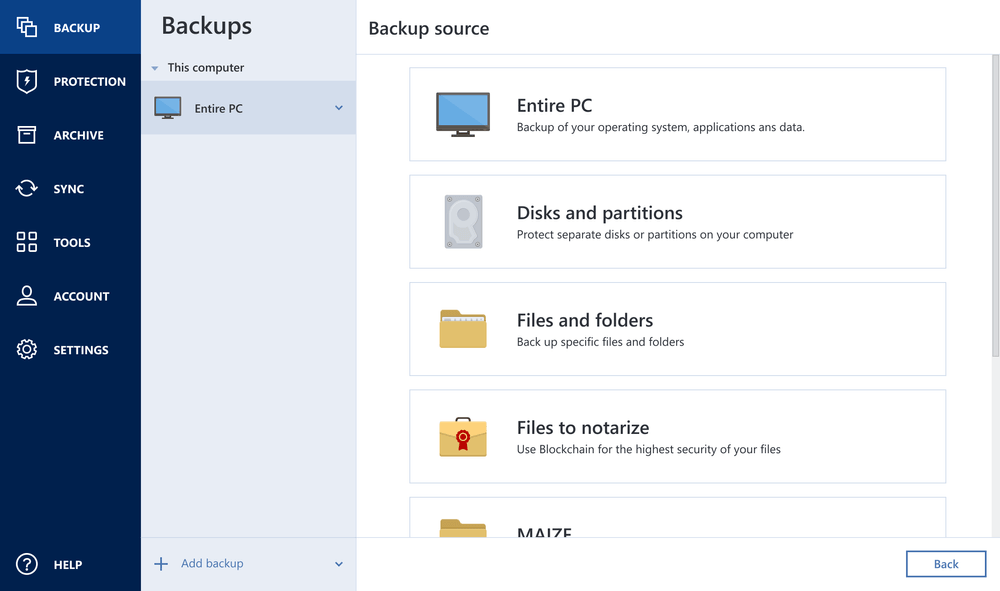
Western Digital does not produce its own proprietary cloning software. Instead, it partners with Acronis to offer Acronis True Image for Western Digital – a branded, limited edition of Acronis True Image that WD users can download for free from the WD support site.
What Acronis True Image WD Edition Provides
- Full disk and partition cloning
- OS migration without reinstallation
- Basic backup and restore functions
- Compatibility with most WD SATA and NVMe drives
Key Limitations to Know Before Relying on It
Despite being the official recommendation, Acronis True Image WD Edition has a set of well-documented restrictions that trip up a lot of users:
- A WD drive must be detected at launch. The software actively checks for a connected Western Digital drive. If none is found – or the drive isn’t properly recognized – it either refuses to run or prompts you to buy a paid license.
- No exFAT support. Drives formatted with exFAT, which is common on portable WD drives and modern SD cards, are not recognized. You’d need to reformat to FAT32 or NTFS before the software will work with them.
- The clone wizard can freeze. Multiple users have reported the Acronis Clone Disk Wizard stalling mid-process, particularly on older hardware or drives with degraded sectors.
- Cross-brand cloning can be unpredictable. If you’re cloning from a WD drive to a non-WD target (or the reverse), compatibility issues can surface.
For a straightforward WD-to-WD upgrade with no complications, Acronis True Image WD Edition is a serviceable free starting point. For anything more complex, a third-party tool is typically the more reliable choice.
What to Look for in WD Disk Cloning Software
Before comparing specific tools, it helps to know which criteria actually matter in practice:
| Criterion | Why It Matters |
|---|---|
| Brand-agnostic compatibility | You may need to clone to or from a non-WD drive |
| WD drive type support | WD Black NVMe behaves differently from a WD Red HDD |
| Bad sector handling | Aging drives may have unreadable sectors that stall a clone |
| 4K alignment for SSDs | Incorrect alignment measurably degrades SSD performance |
| MBR and GPT support | Required for modern UEFI-based systems |
| Ease of use | Particularly relevant for home and non-technical users |
| WinPE / bootable media | Lets you clone outside of a running OS |
| Price | Free tools exist but vary considerably in what they actually do |
Top 6 WD Disk Cloning Software in 2026
1. Wittytool Disk Clone – Best for SID-Aware Cloning in Windows Environments
Platform: Windows | Price: Free/Paid version start from 19.9$

Wittytool Disk Clone is a disk cloning utility with one differentiating feature that sets it apart from most tools on this list: it combines full disk cloning with automatic Windows SID (Security Identifier) regeneration in a single workflow. That may sound niche, but it solves a real and recurring problem.
When you clone a WD drive and deploy that image to a second machine on the same network, both machines end up sharing an identical SID. This leads to authentication failures, network sharing conflicts, and domain join issues that most cloning tools simply leave you to sort out separately. Wittytool Disk Clone handles it within the clone process itself.
For standard home use, it covers the expected ground: full disk clone, partition clone, HDD-to-SSD migration with 4K alignment, MBR/GPT support, and WD NVMe drive compatibility. It also supports network-based disk cloning, which is useful when you need to push the same image across multiple machines without physically moving drives.
Strengths:
- Disk clone and Windows SID change handled in one pass
- Supports WD NVMe, SATA SSD, and HDD
- Network cloning and PXE boot deployment supported
- Straightforward interface without unnecessary complexity
Limitations:
- Windows only – no Mac support
- For a simple one-time personal backup, it offers more than most home users need
Best suited for: IT administrators, power users, or anyone deploying cloned WD drive images across a network where Windows SID conflicts would otherwise be a problem.
2. Acronis True Image WD Edition – Best Free Option for Simple WD-to-WD Upgrades
Platform: Windows, Mac | Price: Free (requires a connected WD drive)

As covered above, this is WD’s officially recommended tool. For a no-cost, guided upgrade from one WD drive to another, it does the job without any payment required. The interface walks you through the process step by step, which makes it accessible for users who haven’t cloned a drive before.
Strengths:
- Completely free for users with a WD drive connected
- Guided wizard is easy to follow for first-timers
- Mac support is included, which most competitors don’t offer
Limitations:
- Requires a WD drive to be detected at all times during the session
- Does not support exFAT-formatted drives
- Reported stability issues on certain hardware configurations
Best suited for: Home users doing a one-time WD HDD-to-WD SSD upgrade who want a free, guided solution without any technical setup.
3. Macrium Reflect – Best for Scheduled Backup-Style Cloning
Platform: Windows | Price: 30-day free trial; home license from $69.95 (one-time)

Macrium Reflect is a well-established name in disk imaging, and it works cleanly with all WD drive types without any brand restrictions. Its main strength over pure cloning tools is that it combines disk cloning with scheduled incremental and differential imaging – so you get both a one-time clone capability and an ongoing backup system in the same product.
The pricing is a one-time purchase rather than a subscription, which is worth noting given how many alternatives have moved to annual billing.
Strengths:
- Combines cloning with full scheduled backup (incremental and differential)
- Visual disk layout makes it easy to verify what’s being cloned
- Ransomware protection built in
- Bootable rescue media creation included
- Reliable across WD Blue, Black, Red, and NVMe drives
Limitations:
- The 30-day trial is time-limited; after expiry you can only restore, not clone
- No Mac support
- One of the pricier options among the tools listed here
Best suited for: Home users and small businesses who want a mature, stable tool for both cloning and ongoing scheduled drive protection.
4. Rescuezilla – Best Free GUI Option for Cloning Outside of Windows
Platform: Windows, Linux (bootable) | Price: Free

Rescuezilla is an open-source, graphical cloning tool that runs as a bootable live environment based on Ubuntu. Think of it as a user-friendly front-end for Clonezilla – you get much of the same underlying capability without any command-line involvement.
For WD users trying to clone a drive that won’t boot, or a system with OS-level issues, booting from a Rescuezilla USB and running the clone from outside Windows is often the cleanest available approach. We compare it directly against its command-line sibling in our Rescuezilla vs. Clonezilla breakdown.
Strengths:
- Completely free with no feature restrictions or time limits
- Graphical interface – no command-line knowledge required
- Runs from a bootable USB, bypassing OS-level issues entirely
- Works across all WD drive types and brands
Limitations:
- Requires creating a bootable USB drive before you can use it
- Not a native Windows application
- Less granular control over partition resizing compared to paid tools
Best suited for: Users who need to clone a failing WD drive or a system that won’t boot normally, without paying for software.
5. Clonezilla – Best Free Option for Advanced and Enterprise Deployments
Platform: Windows, Mac, Linux (bootable) | Price: Free

Clonezilla is an open-source cloning tool used widely in enterprise environments. Its multicast cloning capability lets you clone one WD source disk to 40 or more target drives simultaneously over a network – something that’s hard to find elsewhere at no cost. It handles bad sector cloning and supports an unusually broad range of file systems.
Strengths:
- No cost, no feature limitations
- Multicast cloning for mass simultaneous deployment
- AES-256 encryption for disk images
- Works with all WD drive types
- Cross-platform via bootable environment
Limitations:
- Command-line interface with a steep learning curve
- Not practical for casual home users
- No built-in GUI for partition resizing
Best suited for: System administrators and advanced users managing WD drives across many machines, particularly where mass deployment is involved.
6. AOMEI Backupper – All-in-One Option with Backup Scheduling
Platform: Windows | Price: Free version available; Standard from $39.95/year
AOMEI Backupper bundles disk cloning, system backup, file backup, and restore into a single interface. The free version covers basic disk cloning, making it genuinely usable without any payment for most personal scenarios. Paid tiers add features like cloud backup, real-time sync, and PXE network boot.
One useful feature in the free version is intelligent sector cloning – it only copies used sectors rather than every sector on the drive, which meaningfully speeds up the process on large drives with lots of empty space.
Strengths:
- Free version includes disk clone without a time limit
- Supports WD HDDs and SSDs (both SATA and NVMe)
- Intelligent sector clone reduces cloning time on partially full drives
- Backup scheduling available alongside cloning
Limitations:
- Dynamic disk cloning and some advanced options require a paid tier
- The interface can feel cluttered given the number of features competing for space
Best suited for: Home users who want both a cloning tool and a backup scheduler in a single free download.
Side-by-Side Comparison Table
| Tool | Price | Free Version | WD NVMe Support | Bad Sector Handling | 4K Alignment | Mac Support | Ease of Use |
|---|---|---|---|---|---|---|---|
| Wittytool Disk Clone | 19.9$ | Yes | Yes | Yes | Yes | No | 4/5 |
| Acronis True Image WD | Free (WD only) | Yes | Partial | No | Yes | Yes | 4/5 |
| Macrium Reflect | $69.95 | 30-day trial | Yes | Yes | Yes | No | 4/5 |
| Rescuezilla | Free | Yes | Yes | Yes | Yes | Yes (bootable) | 3/5 |
| Clonezilla | Free | Yes | Yes | Yes | Yes | Yes (bootable) | 2/5 |
| AOMEI Backupper | $39.95 | Yes | Yes | Paid tier only | Yes | No | 4/5 |
How to Clone a WD Drive Step by Step (Using Wittytool Disk Clone)
The steps below use Wittytool Disk Clone as the example. The general process – select source, select destination, configure settings, start clone – is broadly similar across most tools on this list.
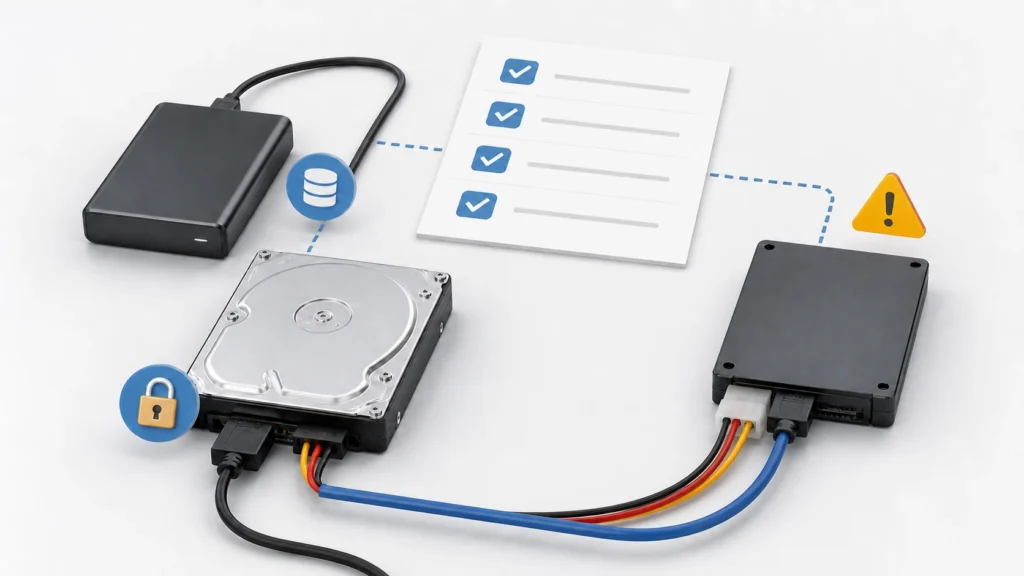
Before You Start: Preparation Checklist
- Connect your target drive (the new SSD or HDD) via SATA cable or a USB-to-SATA adapter
- Confirm the target drive’s capacity is equal to or greater than the used space on your source WD drive
- Back up any existing data on the target drive – it will be completely overwritten
- If the target is a brand-new SSD, no pre-formatting is necessary; the cloning software handles partition creation
- Confirm whether your system uses MBR or GPT by pressing
Win + X, opening Disk Management, right-clicking your disk, and selecting Properties
If you suspect your WD source drive has bad sectors before starting, our guide on WD HDD bad sector repair tools explains how to check and what your options are.
Now download and follow the steps below:
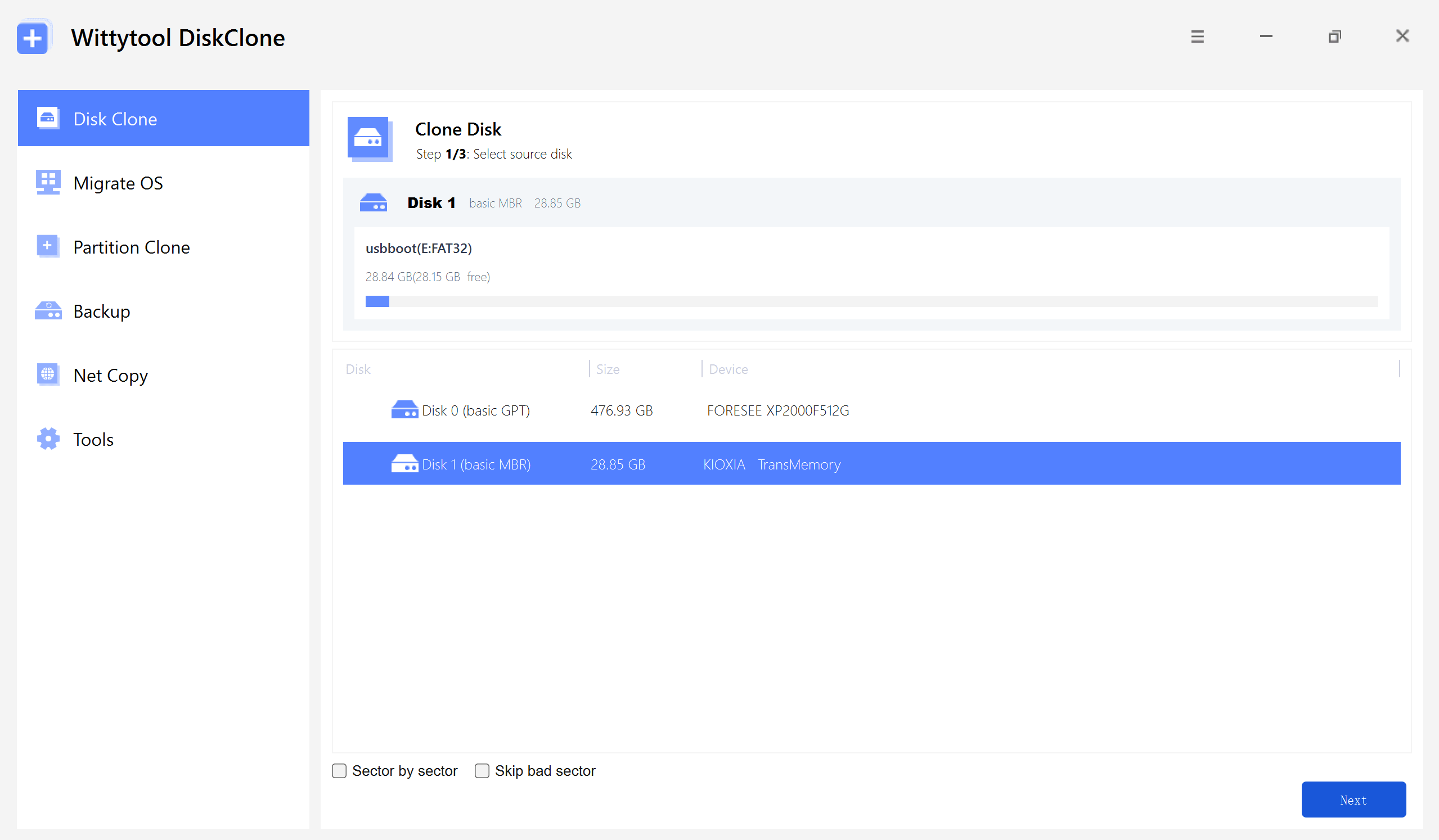
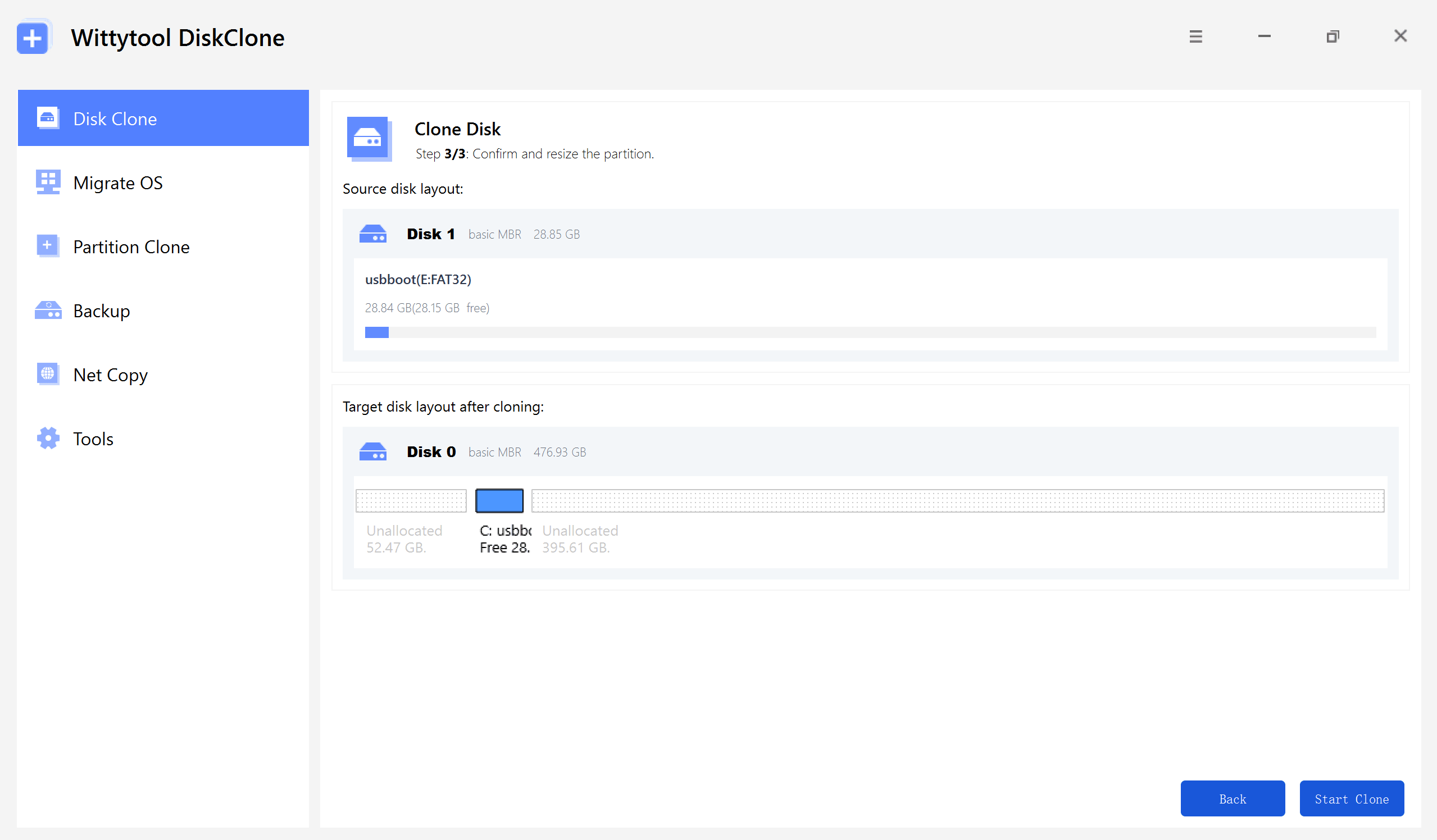
Step 1: Select Disk Clone (or Partition Clone for a nearly identical workflow), then choose your source disk and click Next.

Step 2: Choose your destination disk and click Next to access the configuration settings.
Here, you can enable sector-level cloning, skip bad sectors, or check the UEFI BOOT option to convert the boot mode, ensuring the drive is fully compatible with the UEFI firmware of modern motherboards.
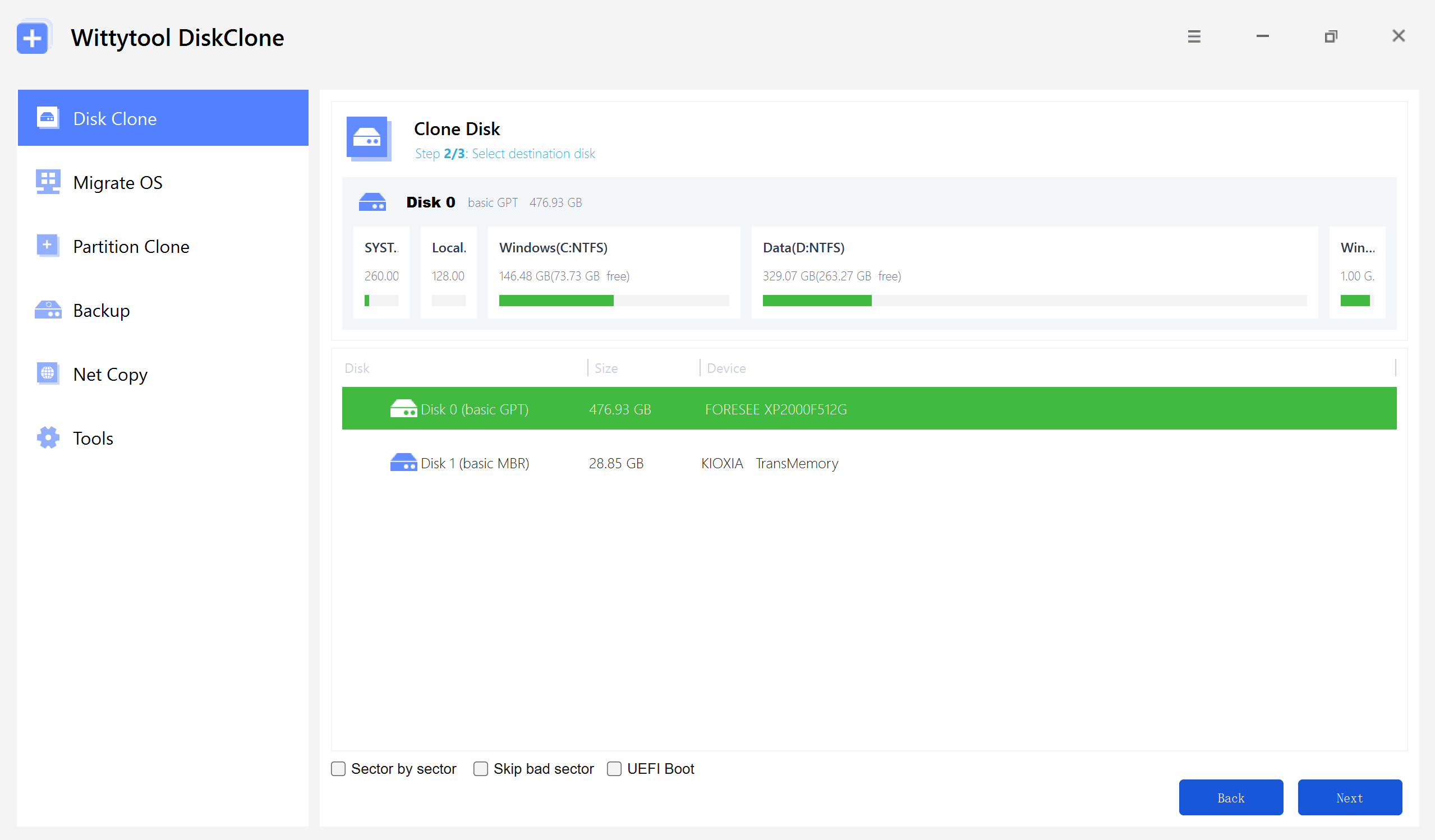
Step 3: Resize the partitions on the target disk layout as needed to fit your requirements, then click the “Start Clone” button to begin the cloning process.

Watch the Disk Cloning Video Guide with Wittytool Disk Clone:
If the cloned drive doesn’t boot, the troubleshooting section below covers the most likely causes.
Which WD Clone Software Is Right for You?
Rather than a single blanket recommendation, here’s a scenario-based guide to help narrow things down.
I’m upgrading my personal WD HDD to an SSD at home
Start with Acronis True Image WD Edition – it’s free and guided. If it doesn’t detect your drive or runs into compatibility issues, Wittytool Disk Clone’s free tier is a reliable fallback.
I need to clone a failing WD drive that has bad sectors
Rescuezilla or Clonezilla are the better choices here. Both run outside of Windows from a bootable USB, which reduces the chance of read errors compounding mid-clone. Before cloning, check our article on how to repair bad sectors to see if any sectors can be recovered first.
I manage multiple machines and need to deploy from a WD drive image
Wittytool Disk Clone if SID management is a concern, or Clonezilla for free multicast deployment across many machines at once. Our guide on network disk cloning covers the network setup.
I want ongoing scheduled backups, not just a one-time clone
Macrium Reflect or AOMEI Backupper – both support scheduling. Macrium Reflect’s incremental imaging is particularly well-suited to a set-and-forget backup workflow.
I’m on a tight budget and need something completely free
Rescuezilla has no time limits and no paywalled features. Clonezilla is the alternative if you’re comfortable working without a traditional GUI. For a wider list of no-cost options, see our roundup of free disk cloning software.
My cloned WD drive won’t boot after I switched it in
This is usually a boot configuration or alignment issue rather than a problem with the clone itself. Jump to the troubleshooting section below, or go straight to our dedicated article on cloned HDD or SSD won’t boot.
Troubleshooting Common WD Cloning Issues
This is an area most guides either skip or touch on only briefly. The problems below come up repeatedly in WD cloning scenarios.
WD Drive Not Detected by the Cloning Software
- Check the physical connection first – reseat the SATA cable or try a different USB port or adapter
- Open Disk Management (
Win + Xthen Disk Management) to see if the drive appears at all. If it shows as “Unknown / Not Initialized,” right-click it and initialize it. Our guide on disk unknown not initialized walks through this in full - Update your storage controller driver via Device Manager
- For Acronis True Image WD Edition specifically: the software won’t run without a recognized WD drive. If yours is connected but not detected, try a different port and confirm it appears in Device Manager before troubleshooting the software itself
Cloning Stuck at 0% or Freezing Part Way Through
This is almost always caused by bad sectors on the source drive. When the cloning software hits a sector it can’t read, it may pause indefinitely waiting for a response that won’t come.
- Run
chkdsk /ron the source WD drive before retrying - Switch to a tool that handles bad sectors explicitly – Rescuezilla and Clonezilla both do this better than most GUI-based tools
- If the drive is producing S.M.A.R.T. warnings, see our article on fixing reallocated sector count warnings and prioritize cloning it sooner rather than later
- For general clone speed problems unrelated to bad sectors, see why cloning a hard drive takes forever
Cloned WD Drive Won’t Boot
The most common post-clone complaint, and almost never caused by data corruption. The usual suspects are:
- The old drive is still set as the primary boot device in BIOS/UEFI
- MBR/GPT mismatch between source and destination (for example, source was MBR, destination was initialized as GPT)
- Secure Boot settings conflicting with the cloned drive – see our article on Secure Boot enabled but not active
- 4K alignment was not enabled during cloning to an SSD, causing boot instability
Full step-by-step resolution is in our guide: Cloned HDD or SSD Won’t Boot.
Clone Failed Because of Bad Sectors on the WD Drive
- Run
chkdsk /r /ffirst and let it attempt a repair - If sectors can’t be repaired, switch to Rescuezilla or Clonezilla, which let you skip unreadable sectors rather than halting the process
- If the drive is already partially failed and data recovery is your priority, our data recovery software may be able to recover files before the drive deteriorates further
Acronis True Image WD Edition Not Working
- Confirm a WD drive is physically connected and visible in Device Manager
- Check whether the drive is exFAT-formatted – this format is unsupported; reformat to NTFS first
- Run the application as Administrator
- If the clone wizard freezes repeatedly, switching to one of the other tools in this guide is typically faster than continuing to troubleshoot Acronis
Frequently Asked Questions
Does WD provide its own free cloning software?
Western Digital does not make its own cloning software. It recommends Acronis True Image for Western Digital – a free branded version of Acronis True Image, downloadable from WD’s support site. It requires at least one connected WD drive to function.
Can I clone a WD drive without reinstalling Windows?
Yes. Every tool on this list performs a full system clone, transferring the operating system, installed applications, settings, and files to the new drive. No reinstallation is required.
How long does it take to clone a WD hard drive?
It depends on how much data is being transferred and the connection type. Cloning 200 GB over USB 3.0 typically takes 30-60 minutes. A direct SATA connection is noticeably faster. Bad sectors on the source drive can extend the time significantly.
Can I clone a larger WD HDD onto a smaller SSD?
Yes, as long as the used space on the source drive is smaller than the total capacity of the target SSD. Most tools support partition shrinking during the clone.
Is it safe to wipe the original WD drive after cloning?
It’s safe once you’ve confirmed the cloned drive boots correctly and all data is accessible. Boot from the clone first, verify everything looks right, and only then erase the source drive.
Does cloning copy bad sectors too?
It depends on the clone mode. Intelligent (used-blocks-only) cloning skips bad sectors in unused space. Sector-by-sector mode attempts to read every sector, which can cause the process to stall when it hits bad ones. Tools like Wittytool Disk Clone offer configurable error-handling for this.
Can I clone a WD external drive?
Yes. All tools listed here support USB-connected external WD drives. If your external drive isn’t being recognized, see our guide on fixing USB drive not showing up in Windows.
Does WD Black come with cloning software?
No. WD Black drives don’t include bundled cloning software. The options are the same as for any other WD drive: Acronis True Image WD Edition (free from WD’s site) or any third-party tool on this list.
Final Verdict
The right WD disk cloning software depends on what you’re actually trying to do.
- For a free guided home upgrade (WD HDD to WD SSD): Acronis True Image WD Edition is worth trying first. If it fails to detect your drive or causes problems, Wittytool Disk Clone is a dependable alternative.
- For reliability and ongoing scheduled backups: Macrium Reflect is a strong, well-rounded option with a generous trial period.
- For cloning a failing drive or one that won’t boot: Rescuezilla is the most practical free tool – no command-line required, no time limits.
- For IT environments and multi-machine WD deployments: Wittytool Disk Clone addresses the SID conflict problem directly in the clone workflow, which saves meaningful time and troubleshooting effort compared to handling it separately.
- For free large-scale deployments: Clonezilla’s multicast capability is genuinely hard to replicate at zero cost.
Whichever tool you land on, the single most important step after cloning is to verify the new drive boots correctly before doing anything to the source drive. A clone that you can’t use is no better than no clone at all. If you run into issues, the troubleshooting section above and our broader disk clone tips library are good places to start.